They feature an automated, motorized brush or wiper system built into the solar panel surface. At programmed intervals (usually daily or twice daily), the mechanism sweeps across the panel to remove sand, dust, and bird droppings, ensuring the solar cells maintain maximum efficiency without requiring a maintenance crew.
Self-Cleaning Solar Lighting for Dust, Heat and Remote Infrastructure
Self-cleaning solar lamps combine photovoltaic generation, battery storage, LED lighting and a cleaning mechanism intended to reduce dust accumulation on the solar surface. They are designed for roads, parking areas and remote infrastructure where manual maintenance can be difficult.
Engineered for Extreme Desert Conditions
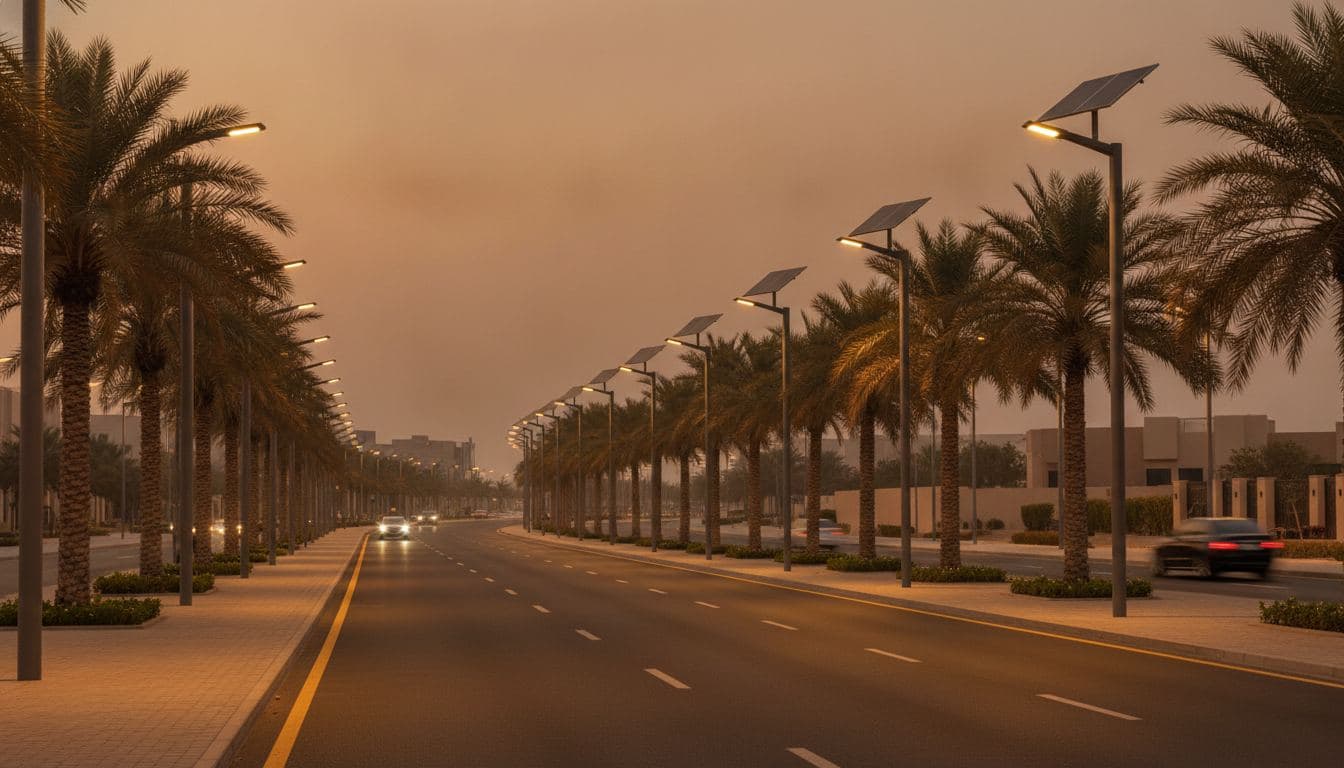
How do self-cleaning solar street lights work?
They feature an automated, motorized brush or wiper system built into the solar panel surface. At programmed intervals (usually daily or twice daily), the mechanism sweeps across the panel to remove sand, dust, and bird droppings, ensuring the solar cells maintain maximum efficiency without requiring a maintenance crew.
Why Dust Reduces Solar-Lighting Performance
In arid and dusty environments, solar panels can lose up to 30% of their generation capacity within a few weeks due to soil accumulation. For off-grid solar street lights, this means the battery fails to fully recharge during the day, leading to the lights turning off prematurely in the middle of the night.
While standard solar lights work well in clean environments, deploying them across kilometres of desert highways or remote industrial compounds creates an impossible maintenance burden. Sending crews with water trucks to clean hundreds of panels manually every week is logistically and financially unviable.
System Architecture
- Integrated PV Module
- Automated Robotic Cleaning Mechanism
- High-Temperature Battery Bank
- Intelligent Lighting Controller (MPPT)
- High-Efficacy LED Luminaire
System Components
Stellar Series Overview
All-in-one and split-type self-cleaning street lights tailored for various pole heights.
For large-scale infrastructure projects requiring minimal maintenance.
Automated Wiper System
Motorized micro-fiber brush that sweeps the panel at set intervals.
Crucial for areas with high dust storms and zero rain.
Adaptive Dimming Controller
Smart management that lowers brightness during low-traffic hours to save battery.
To guarantee light output from dusk till dawn, even during overcast days.
Ideal Applications
Roads and Highways
Providing consistent illumination on long, remote desert highways without grid connection.
Parking Areas
Securing large commercial or industrial parking lots without trenching asphalt.
Border Infrastructure
Illuminating high-security perimeter fences in deep desert environments.
Parks and Pathways
Architectural and functional lighting for municipal parks.
Deployment Process
1. Assess
Determine road width, required pole height, and desired lux levels.
2. Analyse
Calculate the required lumen output and battery autonomy.
3. Design
Complete a Dialux lighting simulation to verify the layout.
4. Configure
Select the appropriate Stellar model and program the cleaning/dimming schedule.
5. Procure and Deploy
Install poles and mount the integrated lighting heads.
6. Monitor and Optimise
Perform long-term checks on battery health and wiper integrity.
Information We Need
- Application type (Highway, Parking, Pedestrian)
- Road or site length / Area dimensions
- Number of lights required
- Required pole height & lux levels
- Dust and temperature conditions
- Existing poles or new installation
Frequently Asked
Request a Solar Lighting Design
Gletscher Energy will review your project requirements and recommend the next technical planning step.
- Engineering review of submitted details
- Initial feasibility assessment
- Direct consultation booking