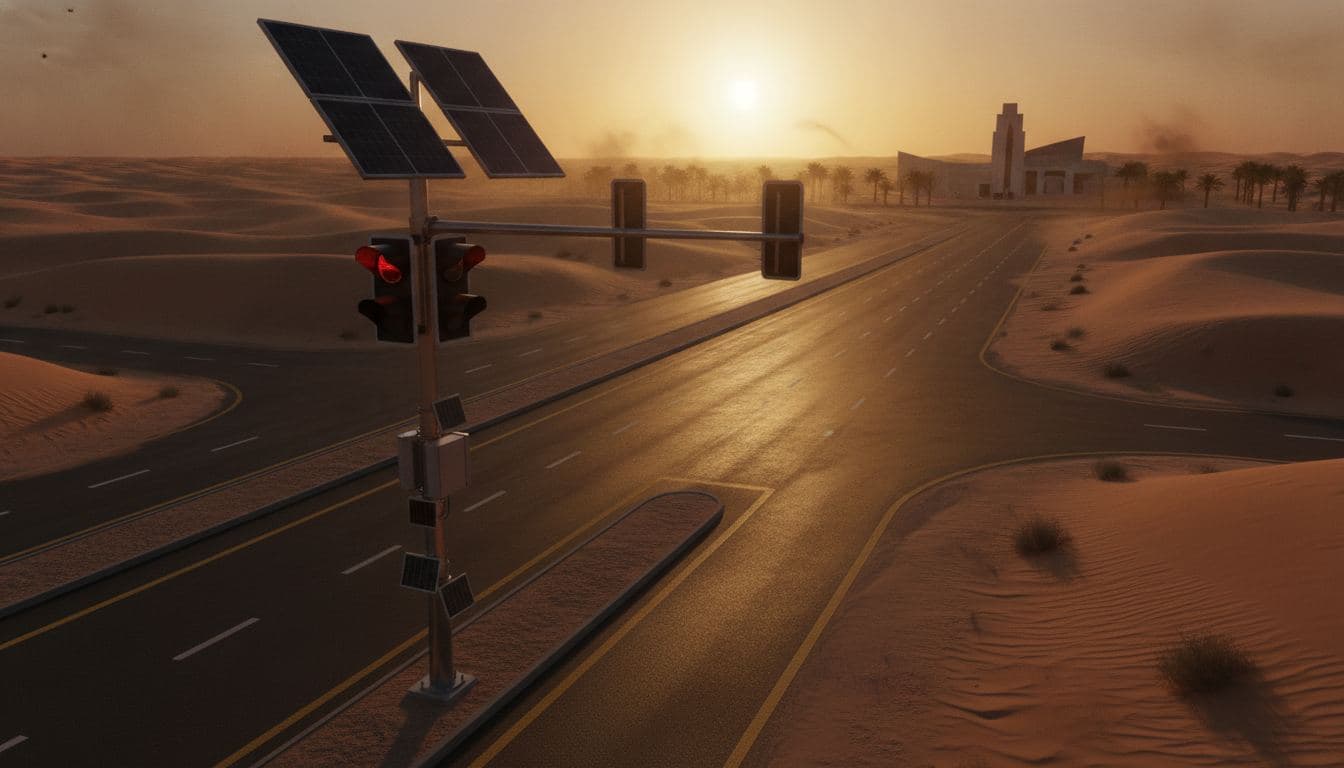
Solar traffic lights use highly efficient LED optics powered directly by a localized battery bank, which is recharged daily by pole-mounted solar panels. They function entirely independently of the utility grid, ensuring intersections remain safely controlled even during regional power outages.
Autonomous Solar Power for Traffic and Road-Safety Systems
Solar traffic-management systems use photovoltaic generation, battery storage and intelligent controls to power traffic signals, warning lights, signs, cameras and road sensors where grid connection is unavailable, costly or temporary.
Reliable Roadway Safety Infrastructure
How do solar traffic lights work?
Solar traffic lights use highly efficient LED optics powered directly by a localized battery bank, which is recharged daily by pole-mounted solar panels. They function entirely independently of the utility grid, ensuring intersections remain safely controlled even during regional power outages.
Traffic Infrastructure Challenges Beyond the Grid
Expanding roadways, constructing temporary detours, or upgrading remote intersections requires immediate traffic control. However, waiting for utility companies to trench cables and provide grid connections can delay critical safety deployments by months.
Relying on grid power for critical intersections poses a severe safety risk during blackouts. A solar-powered solution offers rapid deployment, immunity from grid failures, and eliminates the civil engineering costs associated with long cable runs.
System Architecture
- Pole-Mounted PV Modules
- Intelligent Charge Controller
- Deep-Cycle Battery Storage
- Traffic Controller Unit
- LED Signals & Sensors
System Components
Integrated Solar Signals
All-in-one signal heads with built-in solar panels and batteries.
For rapid deployment of pedestrian crossings or temporary warning beacons.
Centralized Intersection Systems
Large solar arrays powering a master controller and multiple intersection signals.
For permanent, off-grid 4-way intersections.
Digital Signage & VMS
Solar trailers or pole-mounts for Variable Message Signs.
For highway speed warnings and construction zone information.
Ideal Applications
Temporary Work Zones
Portable solar signals that can be moved as construction phases progress.
Remote Intersections
Permanent traffic lights for new developments awaiting grid infrastructure.
Pedestrian Crossings
Push-button activated flashing beacons for school zones and mid-block crossings.
Speed & Radar Signs
Autonomous speed limit indicators to calm traffic on rural highways.
Deployment Process
1. Assess
Determine the intersection complexity, number of signals, and sensors required.
2. Analyse
Calculate 24-hour energy consumption of LEDs and controllers.
3. Design
Size the PV array and batteries to guarantee operation through winter/dust conditions.
4. Configure
Program traffic logic and integrate remote monitoring modules.
5. Procure and Deploy
Deliver components for rapid installation without trenching.
6. Monitor and Optimise
Use telemetry to monitor battery health and preempt maintenance.
Information We Need
- Equipment type (Signals, Beacons, VMS)
- Number of intersections or devices
- Daily operating hours (e.g. 24/7 or school hours)
- Load per device (Watts)
- Required battery autonomy (Days)
- Road or project location
Frequently Asked
Request a Solar Traffic System Assessment
Gletscher Energy will review your project requirements and recommend the next technical planning step.
- Engineering review of submitted details
- Initial feasibility assessment
- Direct consultation booking